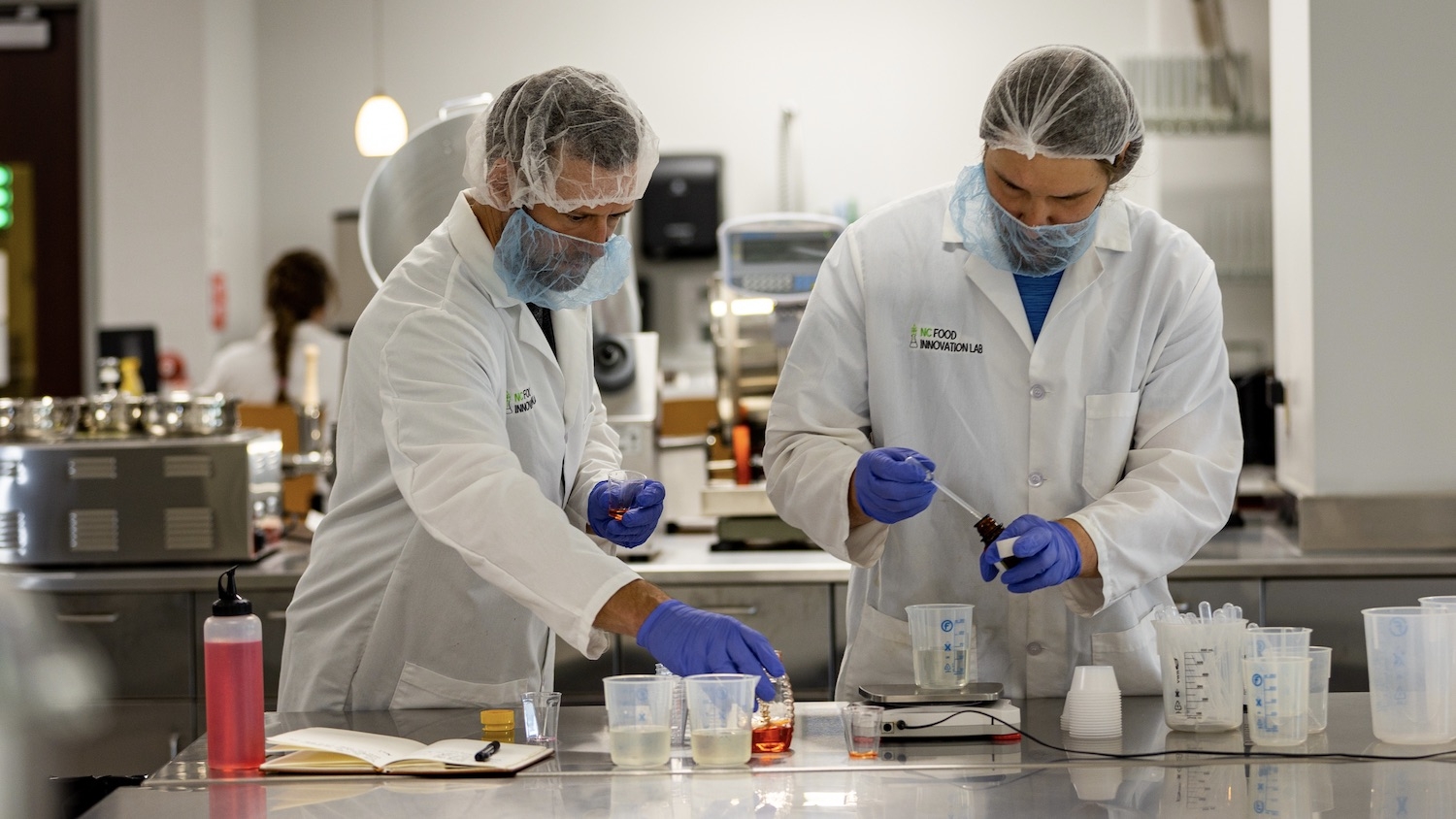
NC Food Innovation Lab (NCFIL) Food Scientist and Product Developer Christopher Patillo started in the world of food wanting to own and operate his own food truck.
After spending a summer in the Charlotte heat working on TIN Kitchen, a Korean-Indian fusion food truck, he abandoned that goal but furthered his love of food.
While Patillo still loves to cook – he can make a “mean” Rogan Josh – his heated food truck experience led him to initially pursue culinary arts education and eventually dive deeper into the science of food.
Now, he is one class away from earning his master’s degree in nutrition at NC State University’s College of Agriculture and Life Sciences (CALS) while working full-time at NCFIL – all for the continuous pursuit of delivering healthier products to market.
A Deeper Understanding of Nutrition
Patillo first arrived at NCFIL in 2021 as a summer intern, having completed his A.A.S. in Culinary Arts in 2019 and working on B.S. in Applied Food Science at Johnson and Wales University.
Following graduation, he became a NCFIL temporary employee, then a permanent food scientist, a position in which he’s thrived. But Patillo wanted to build on his background in culinary arts and food science by gaining a deeper understanding of nutrition, so he embarked on a CALS graduate program.
“Combining these three areas creates a well-balanced foundation of expertise – connecting how food is created, how it performs in a product and how it supports human health,” Patillo says.
He believes studying nutrition helps him better design and develop foods that are “innovative, great tasting, evidence-based and beneficial for consumers.”
Transparent Ingredient Lists, Clean Labels
Within his graduate program, Patillo’s research focuses on consumer perception and formulation of functional beverages, which are liquid foods fortified with ingredients offering certain health benefits.
“I investigate how ingredient choices and labeling influence the way consumers view the product’s helpfulness,” he says, specifically because he has seen a growing consumer preference for transparent ingredient lists and cleaner labels while working at NCFIL.
“There’s a desire for simpler, more natural formulations with clear communications about why certain ingredients are included,” he says. “Beverages need to balance functionality and nutrition to gain consumer trust.”
NCFIL’s “beverage expert,” Patillo has worked on everything from chickpea protein beverages to instantized matcha products to nonalcoholic hibiscus beverages.
Education Applicable to NCFIL
So much of what Patillo has learned in this program is applicable to his work at NCFIL.
In his master’s program, Patillo curbed his electives toward his interests. For example, he is currently taking Fundamentals of Agricultural and Extension Education, which covers topics that connect closely with NCFIL’s mission of educating the community.
Advanced Nutrition and Metabolism, another course Patillo appreciated, emphasized critical thinking and applying research to real-world situations.
“This course specifically impacted how I approach product formulations and how I evaluate ingredients for both function and impact on health,” he says. “Basically, this course helps me link the science of how nutrients work in the body with how I design food and beverage products.”
This education has increased his overall awareness, whether inquiring about processing, investigating how flavors are extracted or considering how ingredients are sourced.
“I now know the average person’s recommended daily intake of proteins, fats and sodium and can modify formulas to meet nutritional targets of NCFIL clients or FDA recommendations,” Patillo says.
He also notes how his consulting skills have developed during his program.
Enhanced Awareness of Nutrition
Patillo’s enhanced awareness of nutrition allows him to better work with equipment and products in which he was already interested, like retorted products and the process of freeze-drying.
He appreciates retorted products because preservatives do not need to be added to make them shelf-stable. And using a freeze-drying process, Patillo explains, allows creation of “a clean mouth feel” while maintaining its nutritional composition and without altering the product.
NCFIL’s analytical equipment also helps its food scientists consider the nutritional quality of food and beverage products.
“Here at NCFIL, we can measure the fat, protein and solid and liquid components, which is helpful because you can take a raw sample and a finished product and compare the nutritional differences,” Patillo says.
Bridging Nutrition Science, Clean Label Design
Patillo seeks to bridge the gap between nutrition science and clean label design, which is a professional pursuit that also supports his personal health and environmental goals.
His master’s program has helped him consider how nutrients affect the body, how to interpret research and how to apply nutrition science in real-world settings.
“This program strengthened my ability to make strong, evidence-based decisions in my work with NCFIL,’ Patillo explains.
And NCFIL Director Julie Mann has taken notice.
“Chris’ three disciplines of culinary experience, food science and nutrition knowledge establish him as a leader in product formulation, sensory measurement and experience, and clean labeling,” she says.
Whether he uses his newly found skills to make a delicious Thai curry or to develop a healthy milk alternative, Patillo looks forward to a fruitful career in which he guides research and development strategies for functional products.
This post was originally published in NC Food Innovation Lab.
- Categories:


