Grad Students Build Bridges for Agricultural Innovation
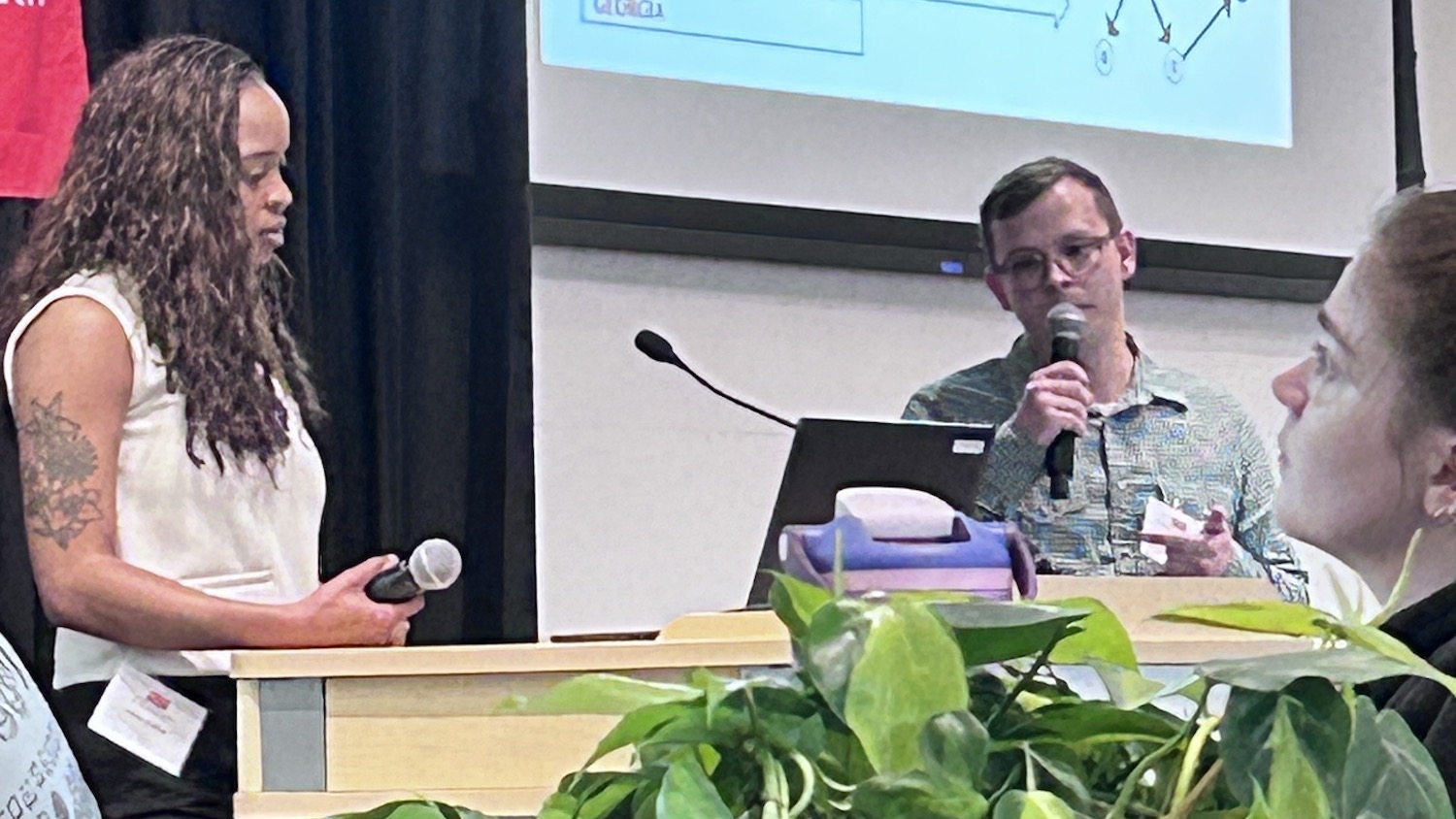
A recent NC State University symposium provided a window into the bold ways graduate students are collaborating across academic fields to solve a range of agricultural challenges, from poor soils to pest damage.
On March 12, eight pairs of students from disciplines — ranging from crop science to electrical engineering — competed in the N.C. Plant Sciences Initiative’s annual BRIDGE Symposium. The event is a partnership with NC State’s Graduate School.
Half of the pairs discussed projects already underway, and half presented ideas for theoretical collaborations.
Daniela Jones, the N.C. PSI platform director for education and workforce development, said that the annual symposium, started in 2024, has proven to be a strong incubator for student-led interdisciplinary ideas.
“It was truly impressive to see the energy and inquisitive mindset of the participating students as they worked together to develop collaborative ideas,” said Jones, an assistant professor of biological and agricultural engineering. “The outcomes reflected many hours of brainstorming, exchanging perspectives and working to understand each other’s expertise to address complex research gaps.”
Unlocking New Paradigms

Bhavya Jain, a doctoral student in electrical and computer engineering, said his biggest lesson learned from the experience was “how transformative interdisciplinary thinking can be when perspectives truly collide.”
“They don’t just add up, they unlock entirely new paradigms of innovation and redefine how we approach complex problems,” Jain added.
“What began as a theoretical idea has the potential to evolve into a high-impact research direction … with real-world implications.”
He and Mariah Saavedra, a master’s student in biomanufacturing, won first place in the theoretical category, proposing research to develop a high-performance battery made from biocompatible and biodegradable materials to power smart-farming sensors.
Second place went to master’s students Jarin Arline (entomology and plant pathology) and Wesley Turner (plant and microbial biology). They proposed research on a novel way to silence genes in guava root-knot nematodes, a threat to U.S.-grown sweetpotatoes.
Other presenters in the theoretical category were:
- Callie Clairborne (plant and microbial biology) and Jacob Grodeon (biological sciences), who proposed combining microbial gut interventions to alter fly diet and sex ratios with acoustic lures to create an effective field trap to control pest populations.
- Lemor Carlton (plant and microbial biology) and Teague McCracken (electrical and computer engineering), who discussed using machine learning to translate knowledge about the genetic interactions in model plants to discovery genetic targets for making corn grown in nutrient-poor soils more resilient.
Jain said his biggest takeaway from the event was realizing how transformative interdisciplinary thinking can be.
“What began as a theoretical idea has the potential to evolve into a high-impact research direction … with real-world implications,” Jain said.
Saavedra also appreciated the chance to connect ideas across different fields to come up with innovative ideas for agriculture.
The symposium experience allowed her to approach problems from multiple perspectives, she said.
The team is already considering next steps. “With the resources and facilities available in my lab, combined with Bhavya’s expertise in battery technologies, we aim to further develop safer and more efficient batteries to support increasingly automated agricultural systems,” she said.
‘A Really Fun Challenge’
In the existing projects category, first-place winners were Zehta Fazler, a doctoral student in genetics and genomics, and Maria Pugliese, who is pursuing combined master’s and doctoral degrees in electrical engineering.

Their project involves using machine learning to sift through massive genomic and RNA-sequencing datasets to prioritize promising gene candidates to accelerate breeding for cold tolerance in corn.
Second-place winners were doctoral students Praneswar Ghosh (crop and soil sciences) and Baha Erim Uzunoglu (electrical and computer engineering. They are developing a low-cost, portable sensor to accurately measure soil CO2 emissions, making soil health monitoring and carbon sequestration verification accessible to farmers and others.
Two other teams rounded out the existing projects category:
- Srinivas Rao Veruganti (crop and soil sciences) and Emily Garceau (electrical and computer engineering) discussed their work to develop an accessible, data-driven dashboard using a soil water budget model to provide farmers with precise irrigation recommendations without the high cost and complexity of current hardware-based solutions or the inaccuracies of large-scale satellite data.
- Caiwang Zheng (horticultural science) and Stefano Fratton (crop and soil sciences) talked about using drone-based hyperspectral imaging coupled with AI to transform subjective, time-consuming visual crop evaluation into a rapid, scalable and data-driven process for plant breeding.
Pugliese and Fazler said they found the symposium a good way to practice communicating complex science to a wide audience. All presenters had to distill their ideas into 6-minutes talks.
As Fazler noted, “It was a really fun challenge to get creative with a talk, rather than approaching it like a typical seminar or class presentation.”
Built on Partnerships
In addition to giving students the chance to build skills in communicating interdisciplinary collaboration and communication, the symposium also provides them with opportunities to network with region’s agricultural technology community.
The event’s judges, all members of the advisory panel for GRAD-AID for Ag, a traineeship program for students working at the intersection of plant science and artificial intelligence, were:
- Joerg Bauer of BASF
- Will Gilbert of IBM
- Charles Hall of Novonesis
- Kevin Donohue of Syngenta
- Hendrik Ypema of UPL
- Pradeep Reddy Marri of Pairwise
- Thais Rodrigues of Nufarm
- Ross Sozzani of Raleigh Biosciences and NC State
Sarah Dinger, the N.C. PSI’s program manager for education and extension outreach, said the judges’ active engagement and the students’ hard work were key to the symposium’s success.
“The judges’ enthusiasm for student research is encouraging, and I think that participants could feel their excitement,” she said. “I also loved to see how the presentations transformed from the first time we saw them to the actual symposium. It was clear that ideas had been reworked and switched around in creative ways for optimal public understanding.”

This post was originally published in Plant Sciences Initiative.
- Categories:


